
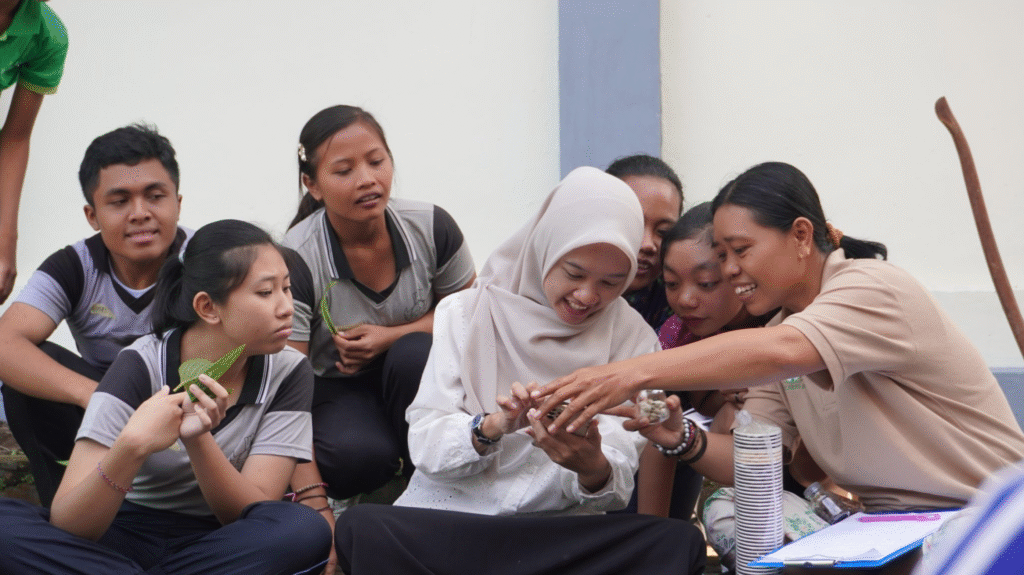
Learning about seed names (Photo: Nicolaus Sulistyo/ IDEP)
In the simple schoolyard, children gathered joyfully. That day, they were not in a classroom lesson. They sat in a circle, introducing their names, hobbies, and each naming plants they had at home.
“What kind of garden do you have?” asked Sayu, a trainer for school gardening.
Using sign language, one of the teachers translated the question for the children. One student responded in sign language, “D-U-R-I-A-N.”
“Oh, durian, I like that too,” replied Sayu.
These children were not just ordinary students. They are children with disabilities. Most of them are deaf and mute. Each child took their chance—touching the soil, sowing seeds, or holding a seedling. Others spread mulch, scattered chopped banana stems, and took turns watering.
This time, we learned together a different kind of language, the universal language: the language of gardening.
This story comes from two special schools in Bali: SLB Negeri 1 Bangli and SLB Negeri 3 Denpasar. These two schools are part of the eco-garden program initiated by Plan Indonesia together with IDEP Selaras Alam, with support from various partners. Here, gardens are not just green spaces, but living laboratories that bring together education, independence, and climate resilience.
From Forgotten Gardens to Learning Spaces: Breathing Life into What is Planted
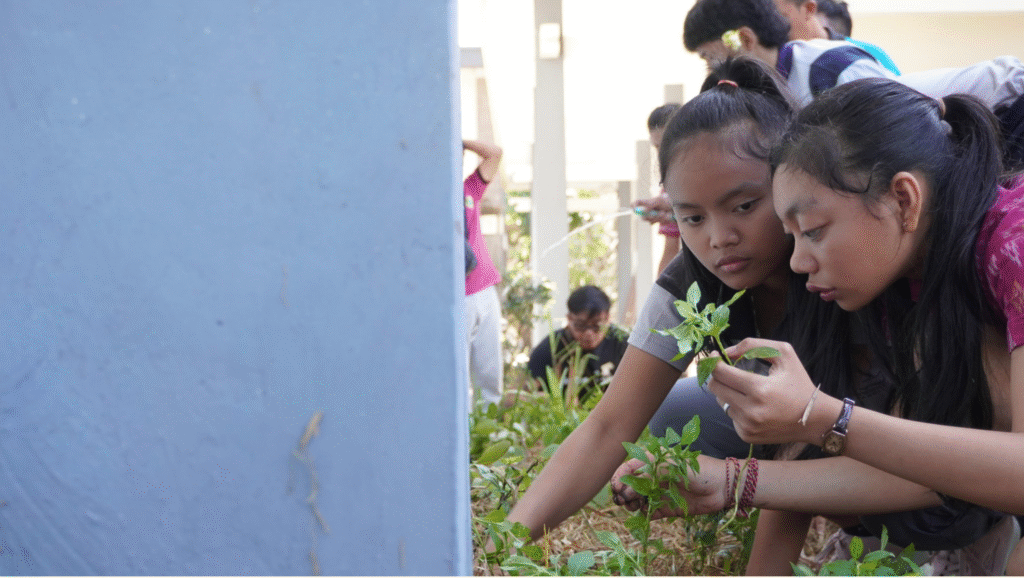
Children at SLBN 1 Bangli planting while observing (Photo: Nicolaus Sulistyo/ IDEP)
SLB Negeri 1 Bangli has a flat land area of 2,300 square meters, but its garden was poorly maintained. The soil was hard, the garden neglected, with only a few surviving plants: ornamentals, aloe vera, turmeric, temulawak, chili, and lemongrass.
Similarly, SLB Negeri 3 Denpasar has a 3,000-square-meter flat land, where many plants were dying due to hard soil and possible frequent waterlogging. Some plants that remained were aloe vera and a few fruit trees.
The soil conditions posed their own challenges. In Bangli, tests showed sandy clay soil with pH 5–6, tending to be acidic and infertile. In Denpasar, clay soil with pH 6 showed medium fertility. Children learned that soil is not just planting media, but a living ecosystem. From there, they were introduced to compost, mulch, and eco-enzyme as ways to nurture earth’s fertility.
Learning with Hands, Hearts, and Senses
The children turned their heads simultaneously.
Sayu raised her hand, showing three small glass jars filled with seeds ready to plant. Each jar contained different types of seeds.
“Now, these three beans we will plant here because they are good for the soil. They make the soil healthy and fertile. And later, when harvested, we can also eat them,” she explained.
At SLBN 1 Bangli, five teachers and 15 twelfth-grade students joined the colorful session. The children were introduced to chemical-free permaculture gardens, learning to distinguish soil textures, smell plant aromas, and practice intercropping. These sensory activities became an important bridge for those who learn differently—that knowledge can be absorbed not only through words but also through touch and experience.
Meanwhile, at SLBN 3 Denpasar, fifteen students and five teachers made seedlings using paper pots, planted, and watered together. They also tried making organic liquid fertilizer and learned how to use eco-enzyme.
“Okay, soon we will learn about the garden, because if we want to plant, the plants and soil need fertilizer. Fertilizer is like food. If we don’t eat, are we healthy? Do we need to eat every day?” Sayu asked the group.
Ade Maya Amyana, Principal of SLBN 3 Denpasar, called this activity a step in building a love for nature. “Our children are taught how to care for the soil to make it fertile. Our hope is that this skill becomes a life skill useful for their future,” she said.
A Space for Inclusion and Independence
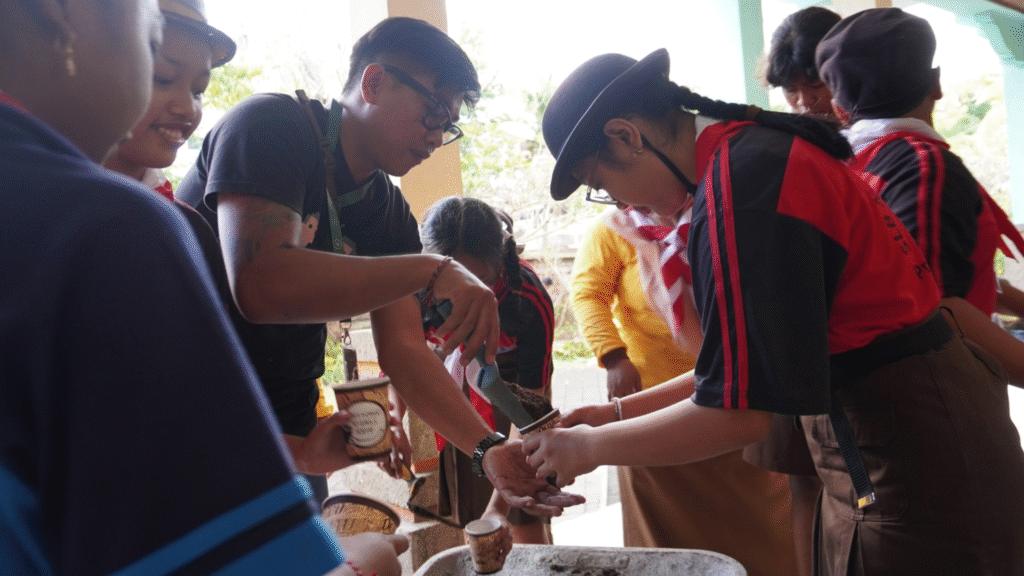
Children at SLBN 3 Denpasar preparing their plants (Photo: Nicolaus Sulistyo/ IDEP)
For students with disabilities, gardening is not only about planting. It is an exercise in patience, a space for social interaction, and an opportunity to feel equal. At SLBN 1 Bangli, Principal I Wayan Mudayana saw real changes: “Hopefully this gardening activity changes children’s habits. From usually just playing, now they play in a different way—while caring for their garden, enjoying the benefits, and hopefully continuing it at home with their parents.”
Gardening activities created a safe space of inclusion. Teachers played a big role in guiding, even using sign language when needed. Sharp tools were used under strict supervision, while children focused on light tasks. With this approach, the children felt valued and capable of contributing within their abilities.
From School to Home, From Children to Communities
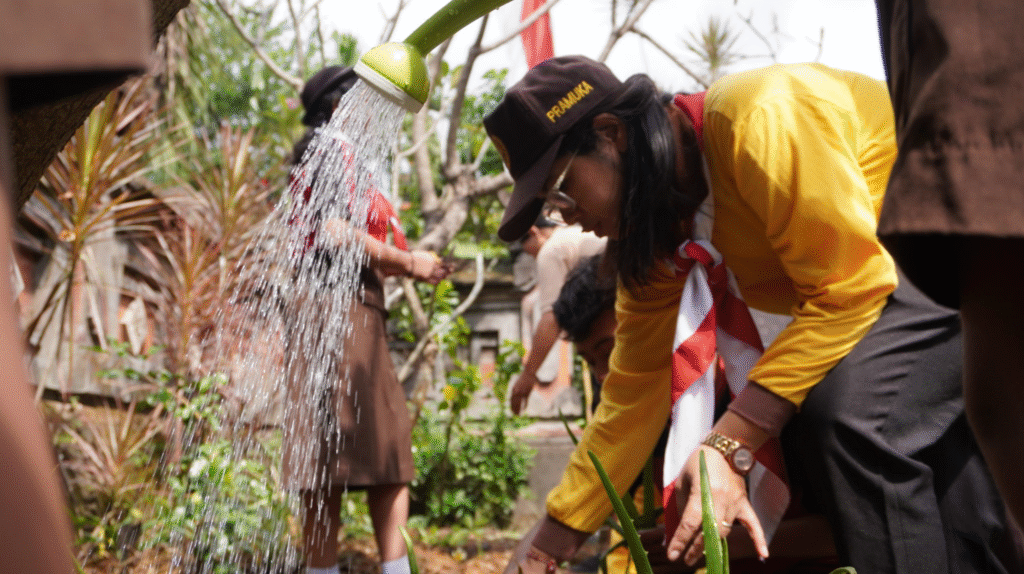
Students and teachers gardening together (Photo: Nicolaus Sulistyo/ IDEP)
These school gardens are not the end goal but the beginning of change. In Bangli, teachers hoped children would continue gardening at home, cultivating small plots for medicinal or simple food plants. In Denpasar, the vision went further: preparing children with life skills so that upon graduation, they not only receive a diploma but also a foundation of independence.
This activity also addressed a global issue: climate change. Through gardens, children learned about natural cycles, the importance of soil care, and how plants could provide cleaner air and healthy food. In simple ways, they were being prepared to become small agents of care for the earth.
Challenges and Hopes
Though full of spirit, the path was not without obstacles. Communication limitations with children with disabilities required intensive assistance. The training duration was only two hours—far from enough to ensure strong skills retention. Gardening facilities were still limited: simple tools, compost, and fertile soil were in great need.
But behind it all, there was a strong signal that change was beginning. Student enthusiasm was high, teachers gained better understanding of organic gardening techniques, and schools started committing to making gardens part of their education.
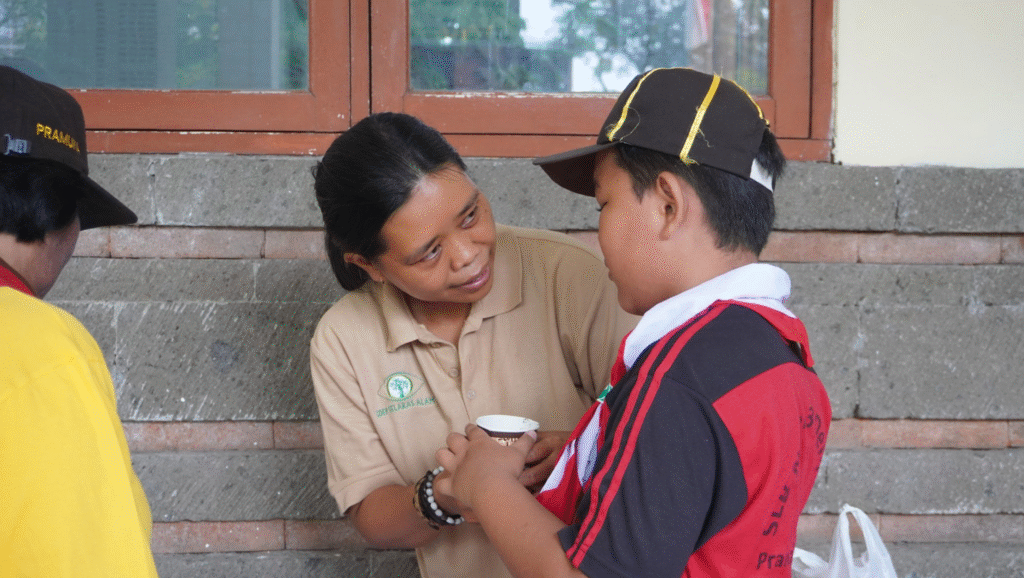
Sayu speaking with one of the children before planting (Photo: Nicolaus Sulistyo/ IDEP)
Article: Nicolaus Sulistyo © IDEP Foundation